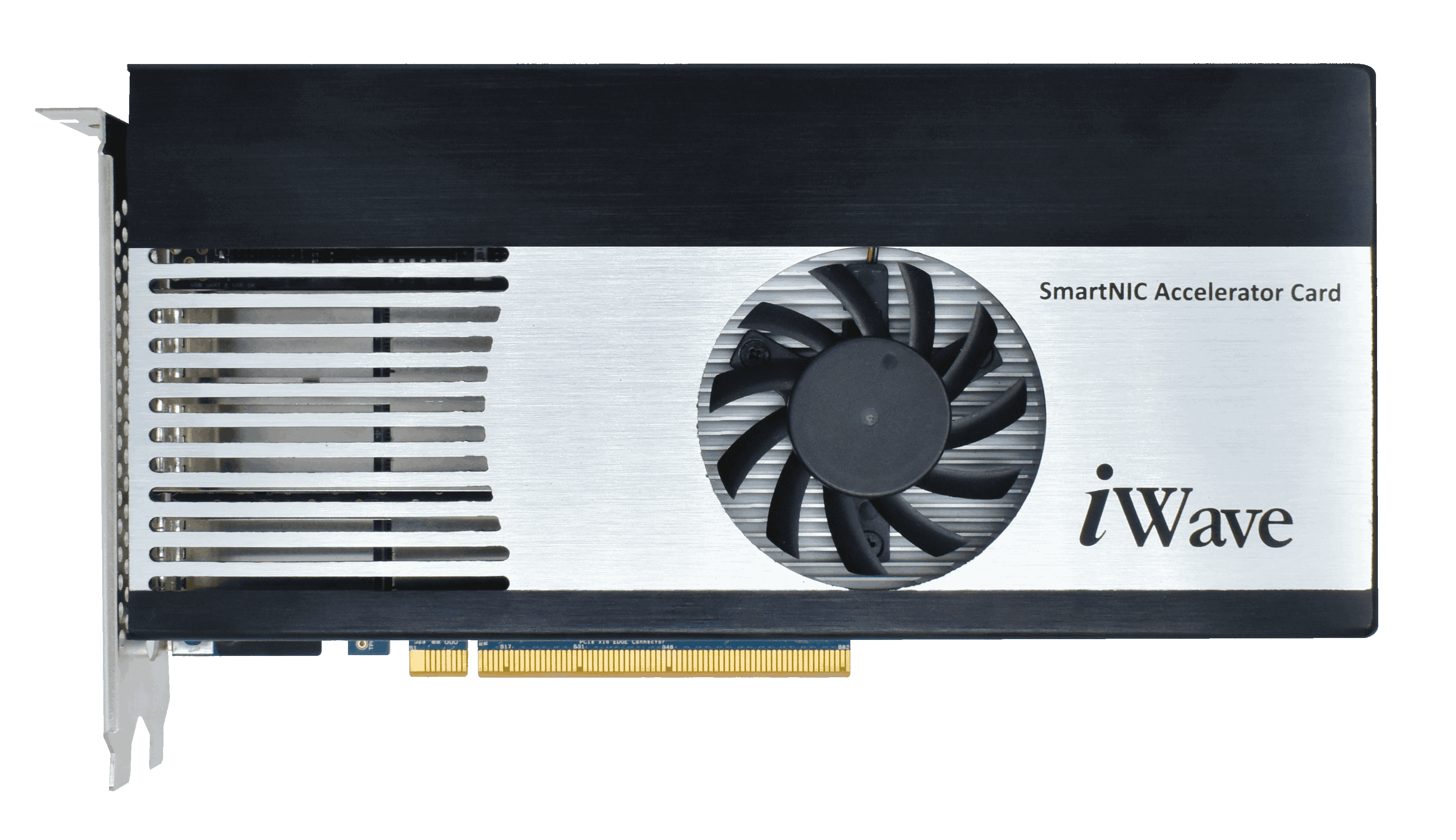
Agilex 7 I-Series R and F Tiles SmartNIC – 400G

Agilex 7 I-Series R and F Tiles SmartNIC – 400G

G43-AFibre-400G

  • 3/4 Length PCIe Gen5 x16 Host Interface
  • Single Front Panel QSFP56-DD Cage
  • Single Front Panel QSFP112-DD Cage
  • Dual Gen4 M.2 NVMe Slots
  • Board Management Controller

PCIe NIC Card

  • 254mm x 111.15mm, 3/4 Length, Full Height, Dual Slot with Active Cooling PCIe Card.
  • Intel Agilex 7 I-Series FPGA
    • Speed Grade: -1 (Transceiver) and –2 (Core)
    • 3 x F-Tiles and 1 x R-Tile Transceiver Tiles
      • 48 x FGT Transceivers upto 58Gbps
      • 8 x FHT Transceivers upto 116Gbps
      • 16 x R-Tile Transceivers upto 32Gbps for PCIe
  • 2,692,760 Logic elements
  • 287 Mb Embedded Memory
  • PCIe Gen5 x16 Host Interface
  • QSFP56-DD Cages (400GbE/200GbE)
    • Line Rates: 1 x 400G, 2 x 200G, 4 x 100G, 8 x 50G, 2 x 40G, 8 x 25G, 8 x 10G
  • QSFP112-DD Cages (800GbE/400GbE)
    • Line Rates: 2 x 400G, 4 x 200G, 8 x 100G, 8 x 50G, 8 x 25G
  • Dual SMA Connectors
  • NVMe Slot – Gen 4 x4 for Storage media over M.2
  • Three DDR4 Channels
    • HPS – Single 8GB, 72b, 3200MHz @409.6 Gbps
    • FPGA – Dual 8GB, 72b, 3200MHz @409.6 Gbps
  • Single OCU Connector
  • Single Quad Core ARM Cortex A53
  • Single USB 2.0
  • 1G Ethernet RJ45
  • 20 pin GPIO for I2C, SPI
  • Max10 Board Management Controller
    • Voltage, Current and Temperature Monitoring
    • Field Updates of FPGA (Partial reconfiguration)
    • FPGA Configuration and Control
    • I2C Bus access
    • Voltage Overrides
  • Storage Media
    • Single 1Gb QSPI to Agilex
    • Single 2Gb QSPI to MAX 10 for Agilex Image
    • 64Mb QSPI to MAX 10 for NIOS FW
    • 32GB HPS eMMC
    • Single Micro SD Slot for HPS

OFS FIM

  • Line rates with F-Tile Ethernet:
    • 400G – 4 x 100G or 8 x 50G
    • 200G – 4 x 50G or 8 x 25G
  • PCIe: F-tile PCIe Gen5x16
  • PCI Capabilities: SR-IOV, ACS, Data Link
  • Hard Processor System (HPS) with 8GB DDR4, x72 (with ECC),
    3200 MHz, 8GB with a max throughput of 409.6 Gbps.
  • Virtualization: 5 physical functions/3 virtual functions with ability to expand.
  • Memory: Two Fabric DDR4 channels, x72 (with ECC), 3200 MHz, 8GB with a max throughput of 409.6 Gbps.
  • BMC:
    • Voltage, current, temperature monitoring and reporting.
    • FPGA configuration over AVSTx8
    • BMC as Root of Trust
    • Supports secure remote system update (RSU) through PCIe

For more information on Intel OFS refer the following Link – https://ofs.github.io/ofs-2024.2-1/

Host Server Environments for OFS

  • Server : Dell PowerEdge R760
  • PCIe : Gen 5 x 16
  • Disk: Free Space up to 50GB
  • Memory: 128GB
  • BIOS: Enable IOMMU, Hugepages, PCI Reallocation, Disable PCI-ASM
  • Supported OS: Ubuntu 22.04, RedHat 8
  • Supported Libraries & Applications: OPAE SDK, HE-Exerciser, LinuxPTP, DPDK

OFS Software

HE-Exerciser
  • The host interacts with the FPGA using the Linux DFL (Device Feature List) and OPAE (Open Programmable Accelerator Engine) libraries https://ofs.github.io/ofs-2023.1/sw/fpga_api/prog_guide/FPGA-lib-1.png.
  • HE applications communicate with the HSSI, Loopback, Traffic Generator, and Memory modules within the AFU region of the FPGA.
  • The application also extends its functionality to transmit workloads over
    QSFP ports at various speeds.
DPDK-IFPGA
  • The DPDK based IFPGA libraries help to interact with Management modules.
  • The IFPGA Rawdev Driver utilizes Intel FPGA Software Stack OPAE (Open Programmable Acceleration Engine) for FPGA management.
  • Management Modules include FPGA status check, FPGA reset or reboot, PR reset, Read/Write PCI configuration space, bind or unbind FPGA with kernel drivers.
Linux PTP
  • The kernel exposes ToD IP as a PTP Hardware Clock to the Linux PTP stack, allowing the system clock to synchronize with the ToD information
  • The phc2sys utility to access ToD information and synchronize the system clock.

Copyright © 2022 iWave Systems Technologies Pvt. Ltd.